
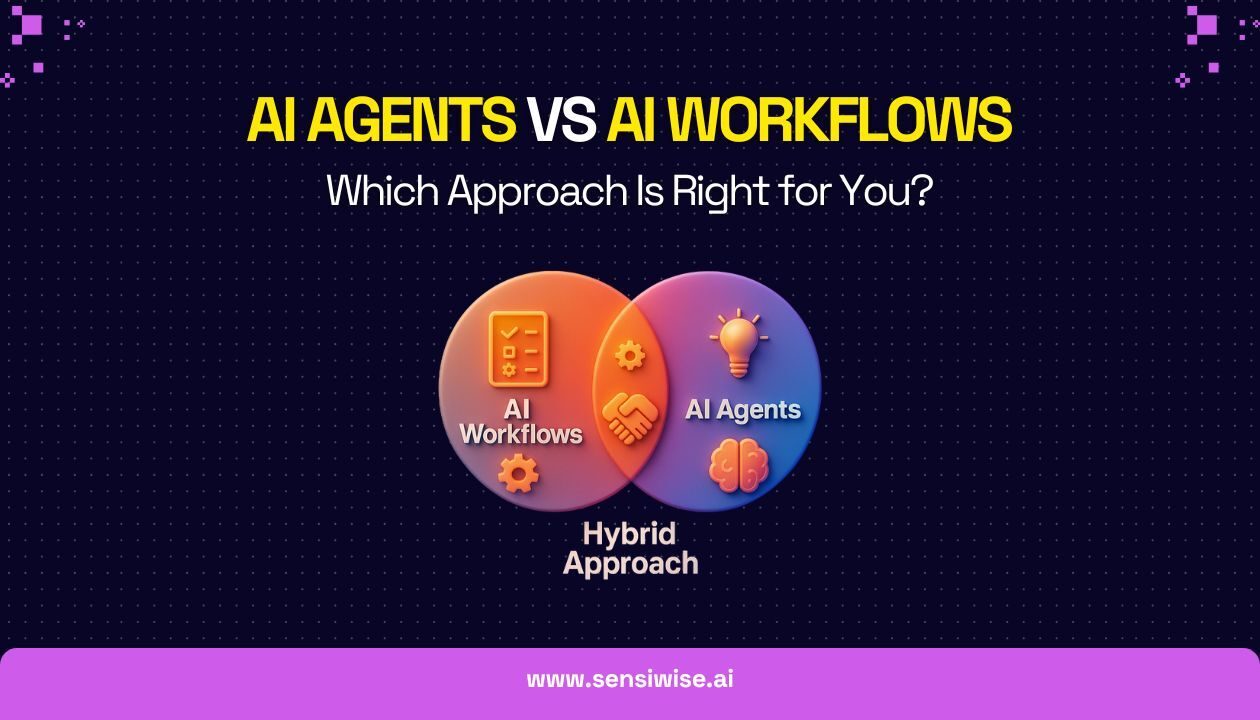
Artificial intelligence service has evolved from being a futuristic buzzword to a foundational pillar of concern innovation. Naturally, whether streamlining internal processes or creating intelligent customer experience, AI now shapes how organisations operate and compete. Importantly, yet as companies integrate AI, a critical question emerges: Should you focus on AI work flow or AI agent? Understanding the departure between these two approaches and knowing when to use each is primary for building an AI strategy that balances efficiency, intelligence, and adaptability.
What Are AI Workflows?
In fact, AI workflows are structured sequences of automated steps designed to perform predictable, repetitious labor. Of course, as digital assembly lines where each step is clearly defined with minimum ambiguity, think of them. These workflows often use machine learning automation flows, where models process data and make predefined decisions within fixed boundaries. Their finish is consistent, accurate, and speed, enabling teams to focus on higher-value work.
Common Use Cases for AI workflows
AI workflows are ideal for:
- Compliance checks and risk assessments to ensure adherence to regulatory frameworks
- Document process and validation for extracting data from invoices, contracts, or forms
- Besides, customer onboarding by automating repetitive verification and setup tasks
- Document process and validation for extracting data from invoices, contracts, or forms
Advantages of AI Workflows
AI workflows don't “ think ” like the world, but they execute flawlessly, making them an excellent fit for predictable, data-driven operations.
- Efficiency and speed: Automate rule found processes at scale
- Consistency: Reduce man error and bias
- Scalability: Once configured, work flow can run 24/7 without supervision
- Transparency: Each step is auditable, supporting compliance
What Are AI Agents?
In contrast, AI Agents are designed to act with a degree of autonomy and intelligence. They don ’ t just follow instructions; they assess context, shuffle decisions, and conform to new information much like a human would. Where workflows rely on static sequences, AI agents learn dynamically using machine learning, reinforcement learning, and natural language apprehension. They can handle ambiguity, converse naturally, and collaborate with other systems or humans to achieve goals.
Common Use Cases for AI agents
- Colloquial AI agents that tailor interactions based on user intent and emotion.
- Systems that detect and resolve anomalies before they escalate
- Agents that analyse data, generate insights, and suggest actions
- Autonomous systems optimising supply chains or logistics in real time
Advantage of AI Agents Autonomy:
- Operate independently with minimal man input.
- Adaptability: Handle unstructured data and novel scenarios
- Intelligence: Continuously improve public presentation utilising feedback loops
- Customer engagement: Deliver personalised and conversational experiences
Although, this autonomy introduces challenges around governance, ethics, and reliability, which must be managed carefully.
AI Workflow Automation vs AI Agent Automation
When comparing AI workflow automation and AI agent automation, it ’ s not about which is superior but which suits your business context. In many real-world scenarios, the two work best together.

The Hybrid AI Approach: Best of Both Worlds
Forward thinking organisations are increasingly adopting a hybrid AI strategy that combines the precision of workflow with the intelligence service of agents.
Besides, for example, an AI work flow might automate the process of customer requests, while an AI agent reviews patterns and identifies exceptions requiring attention. At the end of the day: together, they create a balance between automation efficiency and man-like adaptability.
Basically, at Sensiwise AI, we help business plan such hybrid AI architectures, enabling automation where it’s most efficient and deploying agentic intelligence agencies where human reasoning is essential.
Our AI readiness assessment tool, SAIRA™, helps enterprises evaluate their current AI maturity, identify opportunities. On top of that, design strategies that blend both approaches effectively. Naturally, whether you automatise back-office operations or edifice next-generation customer experiences, sort of, SAIRA™ helps ensure your AI journey is both strategic and sustainable.
Where workflows rely on static sequences, AI agents learn dynamically using machine learning, reinforcement learning, and natural language apprehension. They can handle ambiguity, converse naturally, and collaborate with other systems or humans to achieve goals.
Best Use Cases for AI workflows
If you 're considering where to start, here are a few domains where AI work flow consistently delivers measurable ROI:
- Finance and Banking automate transaction checks, KYC/AML, and abidance reports.
- Healthcare managing patient records, scheduling, and claims processing.
- Human Resources – streamline recruitment screening and employee onboarding.
- Customer Support – triaging tickets and automating responses for common issues.
- On top of that, e-commerce – negotiate product listings, order fulfilment, and returns
Surprisingly, these applications are perfect for companies seeking reliableness and scalability without compromising on compliance or control.
Conclusion
Choosing between AI agents and AI workflows isn’t about picking sides, it’s about aligning technology with your business vision. Work flow brings stability and structure, while agents bring intelligence service and autonomy. Together, they form the foundation of truly transformative AI powered organisations.
Interestingly, at Sensiwise AI, we help you navigate this evolution, designing AI ecosystems that drive performance, invention, and trust. Discover your AI readiness today with SAIRA™.
FAQs: AI Agents vs AI Workflows
While AI agents act autonomously, learning from datum and adapting their action based on context, AI work flow postdates a repair set of rules to perform tasks.
Absolutely. Notably, many modern enterprises combine workflows for structure and agents for adaptability, creating a loanblend model that optimises both efficiency and intelligence.
Finance, health care, and logistics industries see high ROI from AI workflows due to their structured operations and compliance-heavy environments.