
The Royal Society Pairing Scheme is designed to help researchers and policymakers experience each other’s worlds. Every year, about thirty scientists from across the UK are paired with Members of Parliament, peers or civil servants to develop a deeper mutual understanding of how science and policy interact. During the Week in Westminster, participants take part in shadowing, workshops and talks, hear from senior figures such as Chief Scientific Advisers and organisations such as the Institute for Government and the Parliamentary Office of Science and Technology (POST), and develop lasting networks. Later in the year, policymakers visit their paired scientist’s home institutions to see research first‑hand. The scheme, which began in 2001, has paired hundreds of researchers with policymakers and has become an important forum for evidence‑informed decision-making.
In March 2026, I had the privilege of taking part in the scheme on behalf of the University of Essex and Sensiwise AI. As an academic working at the intersection of artificial intelligence and public health, I have long believed that AI can support, not replace, expertise in public institutions. The pairing scheme gave me a unique opportunity to share this perspective with policymakers while learning first‑hand how decisions are made in Westminster.
Meeting my pairings
My primary civil service partner was Sarah Garman, Senior Emergency Preparedness Manager at the UK Health Security Agency (UKHSA). Sarah leads preparedness and response work for infectious diseases in London. Our conversations were an eye‑opening tour of the challenges faced by health protection teams: balancing data privacy with the need for timely information, coordinating across local authorities, and maintaining public trust. Sarah’s insight was invaluable when discussing how AI tools such as Copilot might be used responsibly in case management and contact tracing. She emphasised that any AI system deployed within UKHSA must operate within strict governance frameworks and respect patient identifiable information.
My second civil service partner was Andrew Kaye, a policy advisor from the Government Office for Science (GO Science). Andrew’s portfolio includes horizon scanning and digital transformation projects. He provided a complementary perspective to Sarah’s operational focus. We discussed the importance of AI readiness assessments and capacity building across departments, as well as the need for clear guidance from the centre of government on AI ethics and procurement. Andrew was also interested in our Sensiwise AI Readiness Framework (SAIRA) and how it could inform public sector digital strategies.
Both Sarah and Andrew were generous with their time, and our informal discussions helped build personal connections that I hope will persist long after the week in Westminster.
Monday: Immersion in Parliament
The Week in Westminster began on Monday, 16 March at Carlton House Terrace. After arriving at the Royal Society, participants enjoyed networking and a tour of the Society’s historic library and archives. The formal programme opened with remarks from Charlie Christison, Head of Public Affairs at the Royal Society, and Chris Jones, the Society’s Director of Policy. We then heard a fascinating presentation from the Institute for Government on how government and Parliament work. As a newcomer to Westminster, I appreciated this crash course on parliamentary procedure, select committees and ministerial responsibilities.
Late in the morning, we learned about the Lords Science and Technology Committee and the Parliamentary Office of Science and Technology (POST). POST advisers provide impartial, non‑partisan analysis to help Parliament understand scientific issues. Their role underscores the importance of evidence in policymaking and the value of translating complex research into accessible briefings, an exercise not dissimilar from summarising AI research for health practitioners. After lunch, we gathered on the steps of the Royal Society for the first group photograph. The schedule then diverged as scientists met their pairings and shadowed them around Parliament. This part of the scheme encourages one‑on‑one engagement between researchers and policymakers.
Evening Reception
The day culminated with a Parliamentary Reception in the Churchill Room of the House of Commons. The reception, sponsored by Steve Yemm MP, featured speeches from Dame Angela McLean (Government Chief Scientific Adviser). Speakers emphasised that partnerships between scientists and policymakers are essential for addressing complex national challenges, from pandemic preparedness to climate change. Their words echoed the aims of the scheme: to build bridges between researchers and decision makers and to ensure that evidence informs policy.
Tuesday: Exploring Parliament and the GSE Profession
On Tuesday, 17 March, we convened outside the Cromwell Green entrance for tours of Parliament. Seeing the legislative chambers, Westminster Hall and the corridors connecting them was a powerful reminder of the UK’s long democratic history. In Westminster Hall, we gathered for another group photo; the building’s medieval architecture contrasted with the modern debates that take place inside.
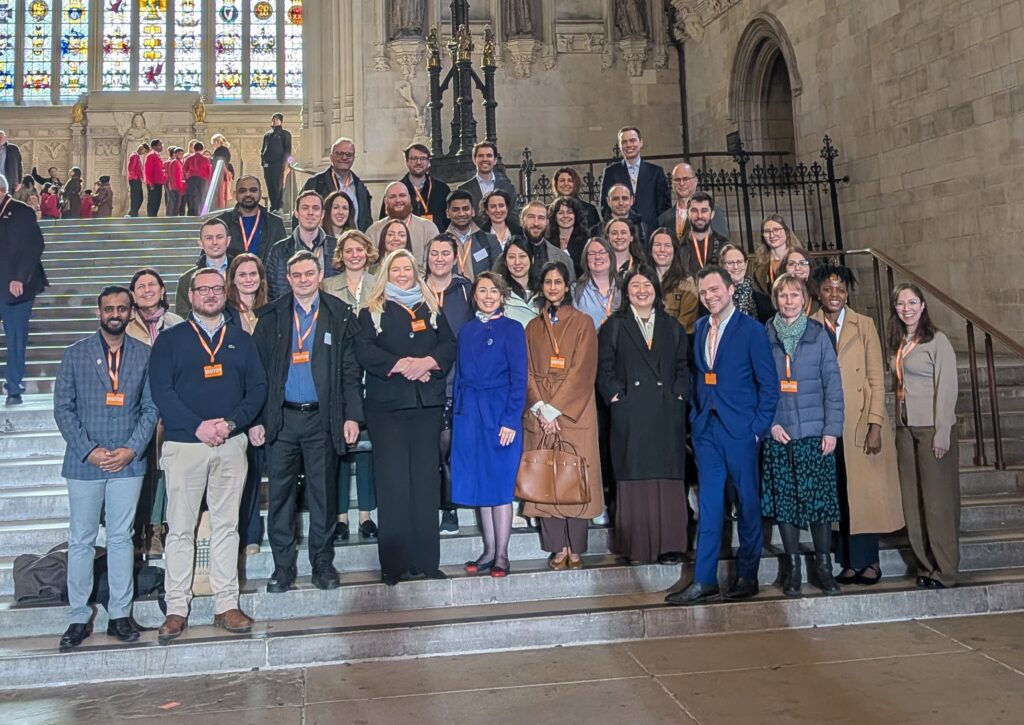
Our visit to the UK Parliament 2026 (image credit: Royal Society Team)
After the tour, scientists travelled to the Thistle Marble Arch Hotel for the Government Science and Engineering (GSE) profession afternoon. The GSE is a community of civil servants with technical backgrounds who support evidence‑informed policymaking across government. The session included talks on career pathways, skills development and the GSE leadership’s priorities. One panel explored how digital and AI skills will become increasingly important for future civil servants, and another discussed diversity and inclusion in science and engineering roles. These discussions resonated strongly with our work at Sensiwise AI on AI upskilling and responsible innovation.
The day closed with informal networking. Many participants commented on how useful it was to see the variety of science and engineering roles in government. The GSE profession afternoon reinforced that building AI capabilities in the public sector requires not just technology but also training, culture change and cross‑departmental support.
During the evening, I met Pam Cox MP, the Member of Parliament for Colchester. As a Colchester resident myself, I was delighted to attend the East of England All-Party Parliamentary Group. Pam shared her interest in strengthening innovation and research links between Colchester and the national government. It was also a pleasure to introduce her to our work at Sensiwise AI; we discussed how AI could support local public services and how the pairing scheme fosters collaboration.
Anticipating Wednesday: A Visit to UKHSA
As part of the scheme, Wednesday morning was set aside for scientists to shadow their counterparts in their home departments. I looked forward to visiting UKHSA’s Canary Wharf headquarters to learn more about its surveillance systems, emergency preparedness plans and digital infrastructure. Sarah planned a tour of the offices, informal introductions with her colleagues, a discussion with the Head of People Development and Engagement and a session with the AI Programme Manager to discuss how UKHSA is adopting AI within its implementation pathway. We were also scheduled to participate in the AI / Copilot Café, an informal gathering of staff across London to share experiences using AI tools. Preparing for this session, I worked with Sarah and Andrew to design a short presentation on practical uses of AI in public health, focusing on summarising case notes, producing draft letters and identifying anomalies in epidemiological data.
The UKHSA visit promised to enrich my understanding of how AI can support infectious disease control. It also provided an opportunity to highlight our work on mobile‑based AI screening tools, such as our research on skin cancer detection, neurological disorder diagnosis and oral pre‑cancer screening, and to discuss how similar techniques might be adapted for respiratory pathogens. Throughout these conversations, we emphasised the need for responsible AI, explainability and human oversight, principles that align with the UKHSA’s cautious approach to patient data.
Reflections on the Pairing Scheme
The first two days of the pairing scheme left a deep impression on me. Seeing policymakers at work dispelled some of the myths about how decisions are made. I was struck by the sincerity with which civil servants and MPs seek evidence to inform policy. Many emphasised that robust evidence is essential for tackling complex problems, a sentiment also expressed in the Royal Society’s communications: the scheme strengthens the relationship between science and evidence‑based decision making and helps Parliament stay connected to the scientific community.
The week also reinforced the importance of communication skills. Translating technical research into language that non‑specialists can understand is a skill often undervalued in academia. Presentations from POST advisers highlighted best practices for writing briefings. During coffee breaks, I practised summarising our AI projects in plain English; by the end of the day, I felt more confident explaining our AI readiness assessment framework to an audience of nurses and policy staff.
Furthermore, the scheme emphasised reciprocity. Later in the year, policymakers will visit our universities and research centres to see our work first‑hand. This reciprocal visit ensures that understanding flows both ways and encourages long‑term relationships. I look forward to welcoming Sarah and Andrew to the University of Essex later this year and showing them our research labs.
Why AI Matters in Public Health
As an AI researcher, I could not help but reflect on how the topics discussed in Westminster intersect with our work at the University of Essex and Sensiwise AI. The UKHSA has adopted Copilot to support some administrative tasks, yet the organisation remains cautious about AI. My discussions with Sarah revealed several reasons for this caution: concerns about data quality, governance, transparency and workforce readiness. These concerns mirror the challenges faced by organisations implementing AI more broadly.
At Sensiwise AI, we advocate for a practical, responsible approach to AI adoption, one that begins with assessing an organisation’s strategy, culture, data maturity, governance and skills. Our SAIRA framework emphasises that AI success depends more on people and processes than on algorithms. It was encouraging to learn that UKHSA’s digital leads are thinking along similar lines: investing in AI literacy, conducting pilot projects with strong oversight and focusing on high‑impact tasks such as surveillance, rapid report writing and decision support. If AI is to support public health staff dealing with notifiable infectious diseases on a daily basis, it must be trustworthy, transparent and aligned with national guidance.
Building Connections for Evidence‑Informed Policy
The Royal Society Pairing Scheme provides a platform for scientists to build enduring connections with policymakers and to share insights that may influence future policy. The communications toolkit underscores this goal: each year, the scheme pairs scientists with policymakers to develop mutual understanding and insight. The immersive programme of shadowing, workshops and talks is designed to provide participants with an insight into how research informs policy. I left Westminster convinced that such programmes are essential for a healthy democracy. At the same time, scientists have responsibilities to engage proactively with policy. During the week, I met researchers from universities and research institutes across the country, from Edinburgh to Sheffield, each bringing expertise in fields as diverse as materials science, microbiology, climate modelling and digital ethics. Many expressed their frustration that research is sometimes misunderstood or ignored by policymakers. Yet all agreed that building relationships and communicating clearly can overcome these barriers. The scheme’s alumni network of more than 700 scientists provides a strong foundation for sustained engagement.
Conclusion and Next Steps
Participating in the Royal Society Pairing Scheme has been an enriching experience. Meeting Sarah Garman and Andrew Kaye has deepened my understanding of the public health and policy landscapes. Visiting Parliament has demystified policymaking and highlighted the vital role of evidence and ethics in government. These insights will shape our work at Sensiwise AI and the University of Essex, informing how we design responsible AI solutions for public health and how we communicate them to non‑technical audiences.
The journey is far from over. Our upcoming visit to UKHSA will allow us to explore practical AI applications in a live public health environment. Later, Sarah and Andrew will visit the University of Essex to learn about our research and discuss how AI can support the NHS and local authorities. Meanwhile, I hope to collaborate with Pam Cox MP to strengthen research links between Colchester and Westminster.