
Artificial Intelligence is transforming the business landscape at an unprecedented pace. Companies across various sectors are recognising the potential of AI to enhance operational efficiency, improve customer experiences, and drive innovation. Yet, for many Small and Medium-sized Enterprises (SMEs) in the UK, the path to successful adoption remains unclear. The pressure to adopt these technologies often leads to speedy decisions, resulting in wasted budgets and stalled projects. Recent studies, including the MIT GenAI Divide report, highlight that most AI failures stem from organisational readiness gaps rather than technology limitations.
This brings us to a critical concept: AI Readiness. It is the measure of an organisation’s ability to not just deploy AI tools, but to integrate them successfully into existing workflows to generate real value. Understanding your readiness level is the single most important step before investing in complex technology.
This article explores why assessing readiness is vital for business leaders and introduces the SAIRA™ framework as a strategic roadmap to guide your journey.
The High Cost of Skipping Readiness
We see a common pattern in the current market. Driven by competitor urgency or board mandates, businesses rush to implement the latest AI solutions. They view AI as a “plug-and-play” commodity rather than a transformative capability. This approach frequently leads to “pilot purgatoryâ€, a state where initial experiments show promise but fail to scale or deliver a return on investment (ROI). The MIT GenAI Divide report highlights that organisations with weak data maturity and governance are significantly less likely to scale AI beyond pilots or Better to add MIT Divide report reference here.Â
When an organisation attempts to build AI capabilities without a solid foundation, several challenges inevitably arise.
Wasted Investment and Resource Drain
The most immediate impact is financial. AI projects are resource intensive. They require significant investment in software, computing power, and talent. If you deploy these resources into an environment that is not prepared to support them, the investment evaporates. For example, buying an advanced machine learning tool is futile if your data is fragmented across incompatible legacy systems. You spend months cleaning data instead of generating insights, draining your budget before the project truly begins.Â
Organisational Misalignment
AI is not solely an IT function; it is a business imperative. A lack of readiness often manifests as a disconnect between technology leaders and business stakeholders. The IT team might build a technically impressive model, but if it does not solve a specific business problem or align with the company’s strategic goals, it adds no value. This misalignment creates friction, reduces stakeholder confidence, and makes it harder to secure buy-in for future initiatives.
Compliance and Governance Risks
For sectors such as healthcare and finance, the stakes are even higher. Jumping into AI without a governance framework exposes the business to severe risks. The regulatory landscape, including GDPR and the upcoming AI Act, demands strict oversight of how data is used and how decisions are automated. An unprepared organisation risks legal penalties and reputational damage by deploying algorithms that are biased, unexplainable, or insecure.
Defining AI Readiness for the SME
True AI readiness extends beyond merely investing in new technologies; it involves embedding AI into the very fabric of the business. It is a holistic state where your people, processes, data, and technology are aligned to support intelligent automation and decision-making.
Being AI-ready means you have moved past the hype. You understand where AI can realistically add value to your specific operations. You have a clear picture of your data landscape. Your team possesses the necessary skills or you have a plan to acquire them. Most importantly, your culture is prepared to embrace change rather than resist it.
Readiness is not a binary state of “ready” or “not ready”. It is a spectrum. A structured self-assessment helps businesses pinpoint their current status on this spectrum. Benchmarking against best-in-class organisations clarifies the journey ahead and highlights common pitfalls, such as siloed efforts or an overemphasis on technology at the expense of business value.
Introducing the SAIRAâ„¢ Framework
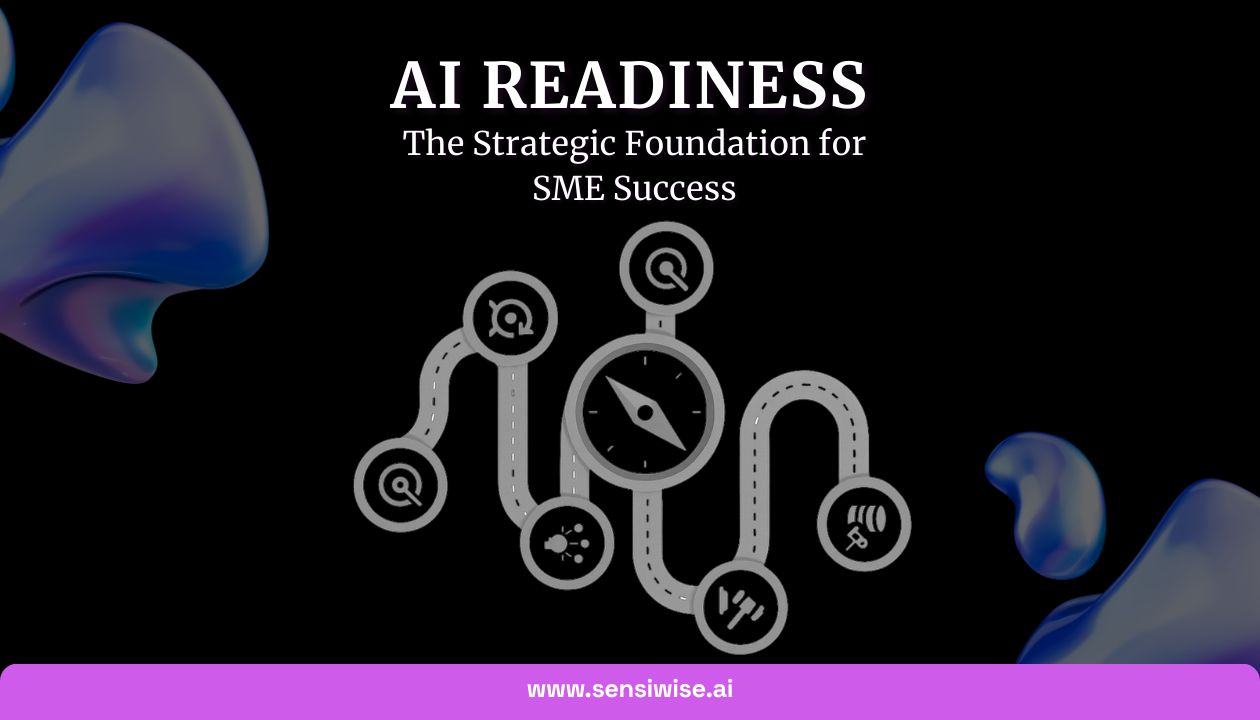
To navigate this complex journey, businesses need a structured approach. The SAIRA™ framework provides a practical, comprehensive model designed specifically to help organisations assess and improve their AI readiness. It breaks down the monolithic challenge of “Digital Transformation” into manageable, actionable components.Â
SAIRAâ„¢ stands for the seven pillars that uphold a successful AI strategy. By addressing each of these pillars, C-Suite leaders can build a robust foundation that supports scalable, value-generating AI initiatives.
1. AI Vision & Strategy
Everything starts with a clear vision. Why do you want to use AI? This pillar focuses on aligning AI initiatives with your broader business objectives. It involves defining clear use cases, whether that is automating customer service, optimising supply chains, or personalising marketing. A strong strategy ensures that every pound spent on AI moves the needle on your key performance indicators (KPIs). Without this, you are merely adopting technology for technology’s sake.
2. People and SkillsÂ
Do you have the right talent to execute your vision? This pillar looks at the skills gap within your organisation. This does not necessarily mean hiring a team of expensive data scientists. It often involves upskilling your existing workforce to become “AI-literate”. Business analysts need to understand what AI can do, and domain experts need to know how to interpret AI outputs. A strategy for training and capacity building is essential.Â
3. Digital Data MaturityÂ
Data is the fuel for any AI engine. This pillar examines the quality, accessibility, and relevance of your data. High-quality data is accurate, complete, and timely. Accessibility ensures that the right systems and people can retrieve this data securely. For many SMEs, this is the biggest hurdle. Moving from disparate spreadsheets to a unified data architecture is often the first tangible step in improving readiness.
4. Process ReadinessÂ
AI works best when it optimises existing, well-defined processes. If a process is broken or inefficient, applying AI will only automate the inefficiency. This pillar involves mapping your current workflows to identify bottlenecks and areas ripe for automation. Streamlining these processes before layering on technology ensures that the integration is seamless and disruptive in the right way.
5. Technology InfrastructureÂ
This pillar assesses whether your current tech stack can support AI workloads. AI applications often require significant processing power and cloud storage capabilities. You must evaluate if your legacy systems can integrate with modern AI tools via APIs or if a more significant infrastructure overhaul is required. Scalability is key here; the infrastructure that supports a small pilot must be able to handle full-scale deployment.
6. Ethics & GovernanceÂ
Trust is the currency of the digital age. This pillar ensures that your AI systems operate within ethical boundaries and legal frameworks. It involves setting up protocols for data privacy, algorithmic fairness, and transparency. For decision-makers, this is about risk mitigation. Ensuring compliance with regulations like GDPR is not optional; it is a fundamental requirement for operating safely.
Unlike generic maturity models, SAIRA™ is designed specifically for SMEs, accounting for limited resources, role overlap, and practical execution constraints.
7. Cultural ReadinessÂ
Technology fails when people do not use it. Cultural readiness addresses the human side of transformation. It measures the organisation’s appetite for innovation and its resilience to change. Leaders must foster a culture where experimentation is encouraged and failure in the pursuit of learning is accepted. If your workforce views AI as a threat to their jobs rather than a tool to enhance their productivity, adoption will stall.
The Strategic Path Forward
Investing in AI readiness yields tangible benefits for organisations. Businesses can expect measurable efficiency gains, smarter and faster decision-making, and significant cost savings. However, these benefits are reserved for those who prepare adequately.
The gap between the AI-haves and the AI-have-nots is widening. Competitors who invest in readiness today will be the market leaders of tomorrow. They will be the ones launching products faster, serving customers better, and operating with leaner overheads.
The journey to AI maturity is a marathon, not a sprint. It begins with an honest assessment of where you stand today. By utilising the SAIRA™ framework, you can identify your strengths and weaknesses across the seven pillars. This diagnostic approach allows you to prioritise your efforts, focusing your budget on the areas that need the most improvement.
For example, if your assessment reveals strong data maturity but weak cultural readiness, you know to invest in change management workshops rather than new servers. If you have a strong vision but poor infrastructure, you can focus on cloud migration. This targeted approach minimises waste and maximises impact.
Take the First Step
We are currently witnessing a shift where AI is moving from a novelty to a necessity. The risk of inaction is now greater than the risk of adoption, provided that adoption is strategic.
Do not let uncertainty paralyse your progress. Start by evaluating your current position. Engage with your leadership team and ask the hard questions about your data, your culture, and your strategy.
We invite you to assess your AI readiness today. By understanding your alignment with the SAIRA™ pillars, you can build a roadmap that unlocks business value and secures your competitive edge. The future belongs to the ready.