PP-01Confirmed
Orders are typed in twice
Every order comes in by email, then someone keys it into Excel and Operations types it again into Sage.
Discovery call · E1.12Quote verified in source
SAILENS™ is the discovery workbench our engineers use. It turns your discovery call, notes and documents into a structured plan: how you work, what slows you down, what is still unknown and what to build first. Every finding links back to the exact words it came from.

Example finding
Every order comes in by email, then someone keys it into Excel and Operations types it again into Sage.
Discovery call · E1.12Quote verified in source
Not covered in the call. Added to the questions for the next conversation.
Open question
After a discovery call, an engineer usually rereads the whole transcript by hand to work out how a business runs, what hurts and what to do next. It takes hours and the result depends on who did it. SAILENS™ does the first pass in minutes, so our engineers spend their time checking and improving the plan instead of starting from a blank page.
We add the call transcript, our notes and any documents you share. Each source is labelled, and every passage keeps its speaker and timestamp.
Specialist AI stages read the evidence: your context, processes, pain points, systems and requirements first, then the gaps, opportunities, a solution and a delivery plan.
Every quoted finding is checked against the original words. Anything that cannot be found in the source is flagged, not trusted.
Our engineer reviews and refines the workspace, then turns it into your discovery report and the questions for the next conversation.
A summary of your business, its goals and the people involved.
How work flows today, step by step: manual steps, handoffs, systems and issues.
What slows you down, each one with the quotes behind it.
The tools you use, where your data lives and how it moves between them.
What a solution must do, grouped, with anything that needs confirming flagged.
A prioritised list of what we still need to learn before we build.
Where AI or automation could help, and the ideas we ruled out, with reasons.
A proposed solution and a backlog of work, separating what is confirmed from what is assumed.
Each client gets one workspace, from the first enquiry to the project. Every area is one click away, and "Show in source" jumps to the exact passage behind a finding.
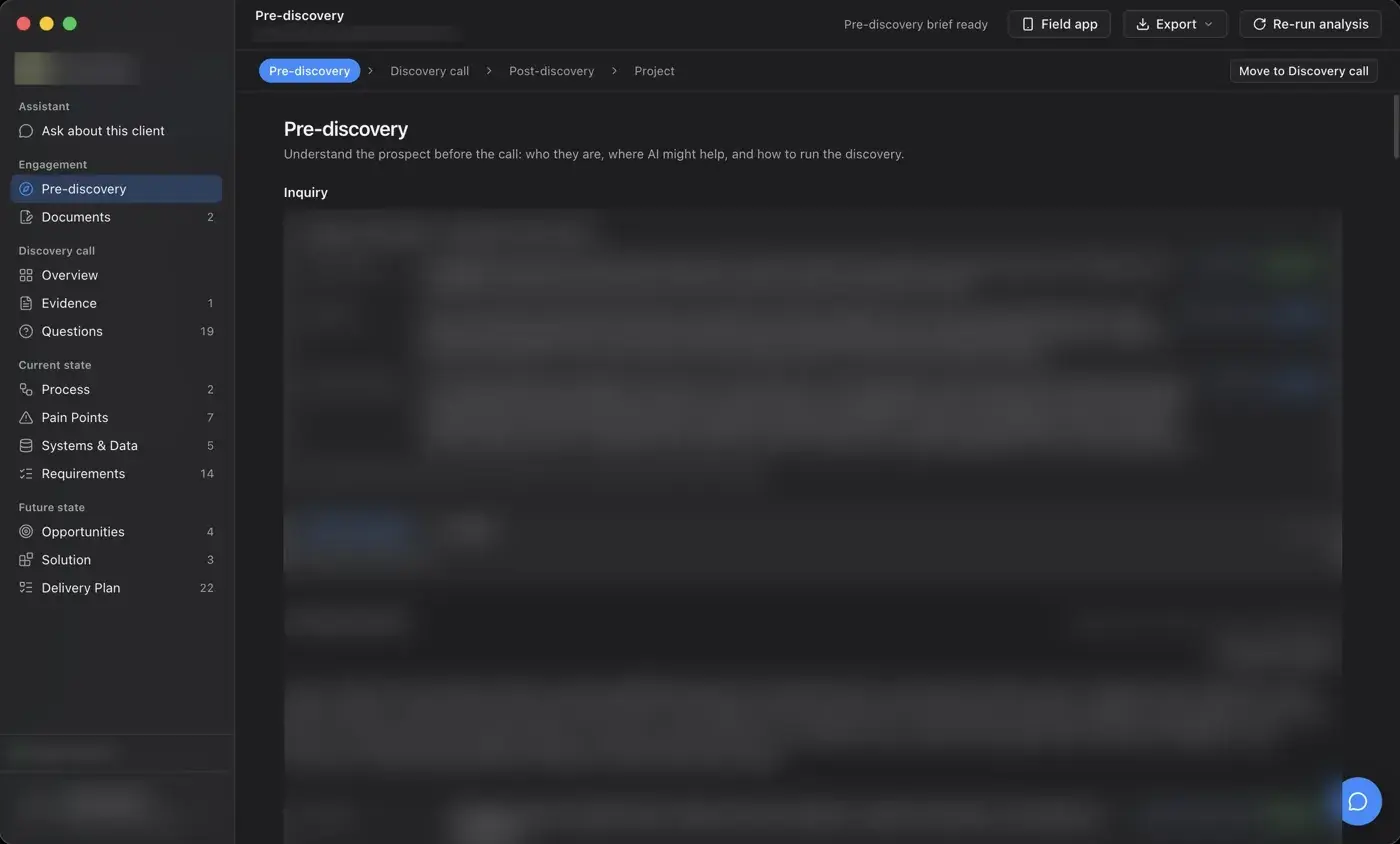
In the workbench’s sample client, orders arrive by email, Sales copies them into a spreadsheet and Operations types them again into the accounts system. SAILENS™ finds that pain point and its quotes, asks how many orders arrive each day instead of guessing, and proposes AI-assisted order intake with a person reviewing each order.
A structured report covering your business, processes, pain points, systems, requirements, opportunities and a proposed plan.
A short, prioritised list of what is still unknown, so the next conversation is focused.
Where AI or automation could help, which to do first and which ideas were ruled out.
The first version of the plan, with the work broken into pieces a team can pick up.
No. SAILENS™ is the workbench our engineers use during discovery. You take part in the conversation, and you receive what comes out of it: the report, the questions and the plan.
No. SAILENS™ prepares a first draft. Our engineers review every finding, check the evidence and agree the plan with you.
It is marked as unknown and becomes a question for the next conversation. SAILENS™ never fills gaps with invented numbers.
We agree confidentiality, such as an NDA, before discovery starts. Ask us for the details of how your information is stored and who can see it.
Tell us how your work runs today, and we will come back with a plan you can check line by line.