
Imagine a busy kitchen. One chef chops vegetables, another stirs the soup, and someone else bakes dessert. Now, picture them all working together perfectly, every move in sync, every dish cooked on time. That’s how computers and AIs like to work, too, through teamwork. However, to come together, they require a common language. For decades, that language has been something called APIs
What we're seeing now is a new, smarter “language” that has arrived called Model Context Protocol (MCP), a framework setting communications protocol for AI agents.
What Is an API (and Why It’s Like a Kitchen Door)?
API stands for Application Programming Interface. API is just a fancy term for the doorway through which two software systems talk to each other. Consider your favourite food delivery app. Notably, when you order pizza, that app doesn’t bake it. Instead, it talks to the restaurant's computer scheme through an API.
The app states, “ Hey, someone wants a large Margherita! ” The restaurant’s scheme replies, “ Got it! It’ll be ready in 20 minutes. ” This back-and-forth happens in seconds, thanks to APIs. When your phone shows the weather, books a taxi, or sends an email, APIs are everywhere. Look, they're like messengers connecting apps so they can share data.
But here comes the challenge:
APIs are brilliant, but they can be fussy. Each system has its own set of rules, like different chefs speaking distinct languages: One says “ salt, ” another says “ NaCl. ” One uses cups, another grams. So, if you want to link up multiple tools, say, an AI model, a web search instrument, and a file reader, you need to set up different APIs for each one. In fact, that way more cables to plug in, more manuals to read, and more mistakes waiting to happen. Usually, for years, tech teams like ours at Sensiwise AI have spent countless hours making these systems get together smoothly using APIs. It plant, but it's like juggling dozens of conversations at once.
Meet MCP: The New Universal Translator
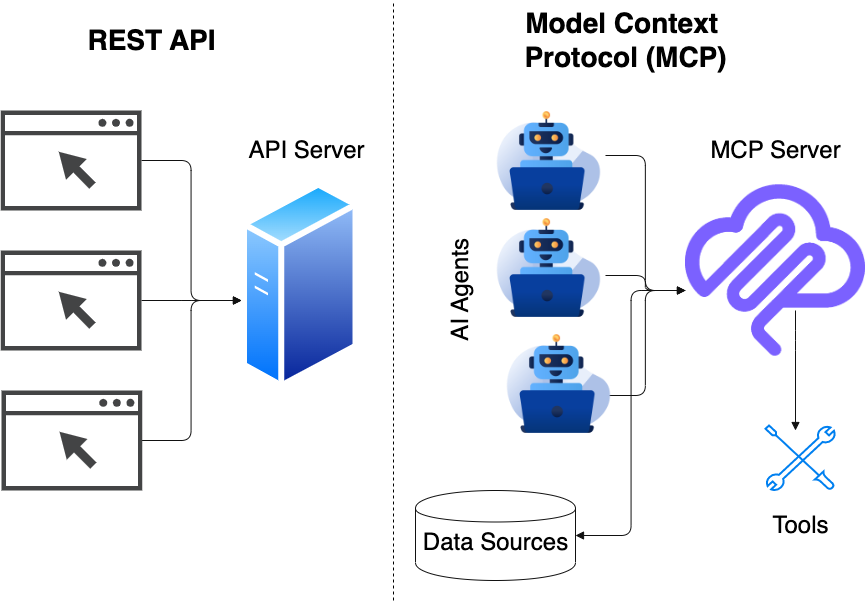
Besides, MCP as the common speech that allows all AIs, tools, and systems to talk without needing alternative translators. Honestly, if APIs are like individual doors between rooms, MCP is a big open hallway where everyone can meet, share information, and get things done faster. It was built for the new world of AI collaboration, where one intelligent system might demand to talk to another, not just exchange data, but part context and understanding.
Hold on, What’s “Context”?
Context means what's going on right now. Plus, when you talk to your grandmother about “the match”, she knows you mean the football match you watched last night, not a matchstick. That's context! MCP gives AIs the same skill. Truth is, it allows the model to remember what’s being discussed, what’s already known, and what’s needed next.
Obviously so, instead of saying:
“Tool A, give me data. Tool B, now process it. Tool C shows results.”
You can just say:
“Hey squad, can we analyse last week’s sales and email me a summary? ”
And all the AI data file readers, analytics tools, and email senders will execute their parts automatically, utilise the shared MCP context.
APIs vs MCP: Spot the Difference
Feature API MCP Purpose Connects one system to another Connects many tools and models together Communication Sends specific requests Shares full context (the big picture) Scalability Works well for single tasks Built for multi-AI teamwork Setup Each connection needs custom code One standard protocol for all tools Understanding Only passes data Passes meaning and memory tooS Analogy Separate doors between rooms One open hall where everyone talks
APIs are like having one phone line for every person you call. MCP is like creating a group chat faster, essentially, really, smarter, and everyone’s in the loop.
Why This Matters for Business
Because of MCP, you can connect an AI tool without endless coding. Data moves smoothly between systems without losing meaning. At the end of the day, businesses can create an agentic AI system, where multiple AIs cooperate like a human team. It’s fast, cheaper, and far easier to preserve.
Imagine your marketing AI agent drafting a campaign, your AI Agent analysing customer trends, and your finance AI checking costs, all communicating seamlessly through MCP.
To be honest, that’s not science fiction anymore; it’s already happening.
Why MCP Is the Future?
Just like the internet needs HTTP to become universal, AI needs MCP to become truly collaborative. It ensures that no matter where a theoretical account comes from, OpenAI, Meta, or Sensiwise AI, they all can speak the same digital language.
Of course, this is what makes the AI ecosystem clear, safe, and interoperable, meaning any company can build and connect tools without getting locked into one platform. If the API is the bridge between two islands, the MCP is the entire highway network connecting cities, towns, and people.
In Simple Words.
APIs were perfect for the old world of Apps. MCP is made for the new universe of AI collaboration, where smart tools think, reason, and act together. At Sensiwise AI, we believe MCP will do for AI what electricity did for machines: make everything work together effortlessly.
Conclusion
Technology shouldn’t feel like a maze of wires and settings. With MCP, the digital universe starts to behave more like citizenry does: apprehension, cooperation, and learning together. So, next time when someone mentions APIs and MCP, just remember this: APIs make Apps talk. MCP helps them understand. And that’s the real magic behind tomorrow’s intelligent scheme.
FAQ'S
That’s a fair question. APIs have done a great job for decades, they’re the reason your apps can book flights, order food, or send messages. But the world has changed. In current times, AI systems need to work together, not just swap data. MCP gives them shared context, meaning they understand the “why” behind each action, not just the “what.” It’s like moving from talking in code words to having a real conversation.
Not really. Think of MCP as an upgrade, not a replacement. APIs are still the building blocks, but MCP builds a smarter layer on top of them.It makes those individual connections flow together, so instead of dozens of separate conversations, you get one coordinated discussion across all your AI tools.
MCP helps different AI tools act like a team rather than a collection of apps. For eg; your analytics AI could pull insights, your marketing AI could turn them into campaigns, and your finance AI could check if it fits the budget, all talking naturally through MCP. Less manual hand-holding, fewer tech headaches, and faster decisions.
That’s the beauty of it. MCP is for everyone. Small and mid-sized businesses can gain even more because it reduces the need for heavy coding or custom integrations. Instead of hiring a team to connect every tool, you can plug them into a shared protocol and start collaborating faster
If APIs are the language of apps, MCP is the language of AI teamwork. You’ll still use APIs for connecting systems, but MCP helps them understand and act together intelligently. The takeaway? Use both. APIs keep your tools connected; MCP makes sure they cooperate.